This article is part of the Mendo Education Series and is intended to help members better understand cannabis products, production methods and member considerations.
Cannabis research has changed considerably as scientists have gained greater ability to isolate and study individual cannabinoids.
THC and CBD remain the most widely recognized, but cannabinoids such as CBG and CBN are increasingly becoming part of the conversation. At the same time, researchers and formulators are examining questions involving cannabinoid ratios, absorption, delivery methods and consistent dosing.
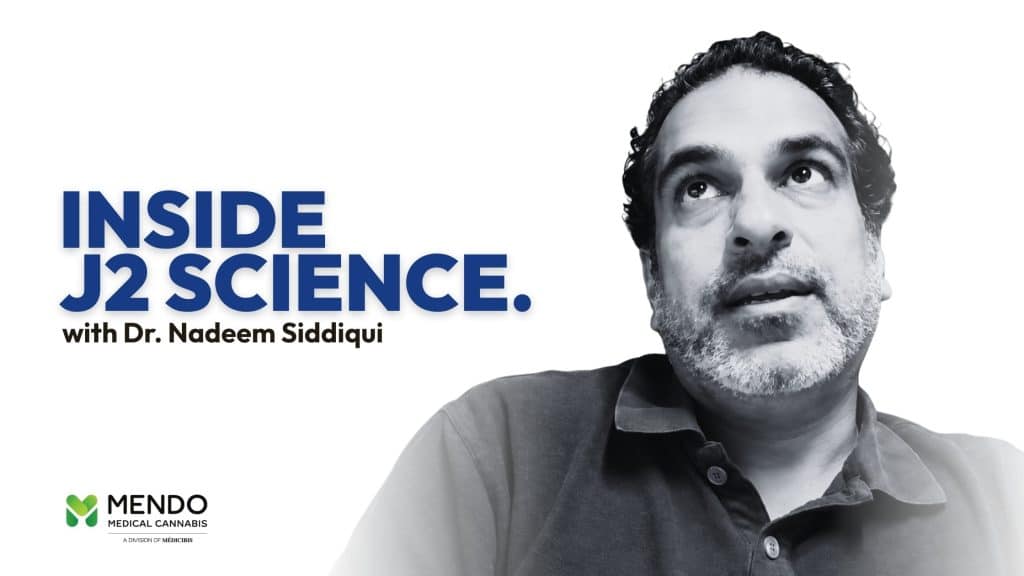
Mendo Medical recently spoke with Dr. Nadeem Siddiqui of J2 Science about his background in biochemistry, the origins of J2 Science and the company’s approach to cannabinoid formulation.
The conversation also explored a broader issue facing medical cannabis: how emerging cannabinoid research can be translated into useful, responsible information for members and healthcare professionals.
Watch the Full Interview
Watch the complete conversation with Dr. Nadeem Siddiqui of J2 Science on the Mendo Medical YouTube channel to hear the discussion about cannabinoid research, minor cannabinoids, formulation, bioavailability, delivery technology and the role of Canada’s medical cannabis channel in full.

From Biochemistry to Cannabinoid Research
Dr. Siddiqui’s background is rooted in academic science. He earned his doctorate in biochemistry and describes spending much of his career within academic environments before entering the cannabis industry.
His work has included involvement with McGill University and the McGill Centre for Cannabis Research, which brings together researchers studying different aspects of cannabis, from cultivation through biochemistry and physiology to clinical research.
Dr. Siddiqui also discussed academic research in his laboratory examining cannabidiol, or CBD, and autism, supported by funding from the Canadian Institutes of Health Research.
When the regulated cannabis industry began developing, he and business partner Alex Azulay saw an opportunity to combine their backgrounds. Alex brought experience from the nutraceutical industry, while Dr. Siddiqui brought his scientific and research background.
“Our whole purpose of coming into the industry was to research and design therapeutic products.”
That objective became the foundation for J2 Science.
Building J2 Science Around Research
Cannabis research looked very different when Dr. Siddiqui and his colleagues first entered the industry.
Research involving cannabis had historically been difficult to conduct, both in Canada and internationally. Funding limitations and regulatory barriers contributed to gaps in modern scientific evidence.
“It took quite a bit of time for the research to accelerate and start supporting the industry with real information.”
As research expanded, so did the technology available to scientists. Researchers became increasingly able to isolate individual cannabinoids and investigate them separately. For J2 Science, that created an opportunity to begin thinking differently about cannabinoid formulations.
Rather than focusing exclusively on THC or CBD, the company began examining how multiple cannabinoids could be incorporated into defined formulations.
Looking Beyond THC and CBD
THC has historically received much of the attention within Canada’s cannabis market.
Dr. Siddiqui believes advances in cannabinoid isolation and research have made it possible to ask more detailed questions about other components of the plant.
During the conversation, he discusses four cannabinoids in particular:
- THC
- CBD
- CBG
- CBN
“The whole idea was to understand what each of them do as best as we can with the approaches that we have, and then reformulate it in a targeted manner.”
J2 Science has used that approach to develop multi-cannabinoid formulations containing predetermined amounts and ratios of different cannabinoids.
Dr. Siddiqui also discusses the distinction between formulations created using isolated cannabinoids and those using full-spectrum extracts.
Research into many minor cannabinoids remains developing. The presence of a particular cannabinoid or ratio does not establish that a formulation will produce a specific medical outcome for an individual member.
What it does provide is another area for researchers to investigate as cannabinoid science continues to develop.
Why Cannabinoid Ratios Matter
One example Dr. Siddiqui discusses is a multi-cannabinoid formulation developed by J2 Science containing THC, CBD, CBG and CBN.
Rather than looking only at the total amount of THC, the formulation was designed around defined quantities of several cannabinoids. This represents a different way of thinking about cannabis formulation.
For members, cannabinoid ratios can provide additional information about what is contained in a product. Two products containing the same amount of THC, for example, may have very different amounts of CBD or other cannabinoids.
Members should review the specific product label to understand the cannabinoid content and ratio of any cannabis product they receive.
Those considering cannabis for a medical purpose should discuss individual dosing and cannabinoid selection with a qualified healthcare professional.
Understanding Cannabinoid Absorption
One of the more technical parts of the conversation focused on what happens after a cannabinoid is consumed.
Cannabinoids are naturally lipophilic, meaning they have an affinity for fats rather than water. Dr. Siddiqui explains that this can influence how cannabinoids are absorbed by the body.
Taking a particular number of milligrams does not necessarily mean that the same quantity reaches systemic circulation. Absorption can vary based on factors including the formulation, what a person has eaten and individual physiology.
This introduces an important concept in cannabinoid research: bioavailability. Bioavailability generally refers to the proportion of an administered substance that reaches systemic circulation.
For cannabis formulation, this means the amount of a cannabinoid listed on a label is only one part of understanding how a product has been designed.
J2 Science’s Approach to Nanoemulsification
One technology discussed during the interview is nanoemulsification.
Cannabinoids are oil-based compounds, which creates formulation challenges when incorporating them into water-based products. Dr. Siddiqui explains that nanoemulsification can be used to disperse these oil-based compounds into much smaller droplets within a liquid formulation.
J2 Science has incorporated emulsification technology into some of its sprays and liquid ampule formats According to Dr. Siddiqui, published research has examined how these types of formulation techniques can influence cannabinoid absorption. For members, this highlights another distinction between cannabis products.
Two formulations containing the same labelled quantity of a cannabinoid may still differ in carrier ingredients, manufacturing processes and delivery technology.
The Challenge of Consistent Dosing
The discussion about bioavailability leads into another important topic: dosing.
Dr. Siddiqui recalls this being a significant concern for healthcare professionals during the earlier years of medical cannabis.
Traditional pharmaceutical products generally provide clinicians with established dosing information supported by clinical research. Cannabis has historically presented additional variables, including differences in plant material, formulation, administration method and individual response.
“The key thing is just to figure out what are the beneficial doses and how precise you can be.”
J2 Science has explored measured delivery formats as one way of creating more precisely defined cannabinoid formulations. This does not mean that a particular measured dose will be appropriate for every member.
There is no universal cannabis dose suitable for every individual or medical situation. Members should discuss dosing, medical history, existing medications and potential interactions with an appropriately qualified healthcare professional.
Understanding the J2 Science Brand Portfolio
J2 Science operates several brands designed for different parts of the Canadian cannabis market.
During the interview, Dr. Siddiqui discusses Jane & Juice, Revita and Ledose.
Jane & Juice
Jane & Juice was the company’s first brand and was developed primarily for the adult-use retail environment.
Dr. Siddiqui explains that some of the formulations and technologies used within Jane & Juice can also appear elsewhere in J2 Science’s portfolio in different formats.
Revida
Revida was developed with a greater emphasis on medical cannabis education.
According to Dr. Siddiqui, educational materials associated with the brand were intended to provide additional information about formulation, dosing and how particular product formats are used.
This reflects the different questions that may arise within a medical cannabis setting compared with recreational retail.
La Doze
La Doze focuses on J2 Science’s emulsified formulations and measured spray delivery.
Dr. Siddiqui describes spray formats designed to provide a defined amount of cannabinoids with each actuation, depending on the specific formulation.
The company has also explored formulations incorporating cannabinoids such as CBD, CBG and CBN without making THC the primary focus.
Members should always review the label of a specific product, as cannabinoid content and ratios can vary between formulations.
The Growing Interest in Minor Cannabinoids
One of the clearest themes throughout the conversation is the increasing interest in cannabinoids beyond THC.
For much of Canada’s legal cannabis market, THC percentage has been one of the most visible numbers associated with a product. Dr. Siddiqui believes this can create an incomplete picture.
CBG and CBN, for example, are increasingly appearing in cannabinoid research and commercial formulations alongside CBD and THC.
The science surrounding many minor cannabinoids remains developing, and emerging research should not be interpreted as evidence that a particular product will produce a specific therapeutic outcome.
However, the ability to isolate these compounds gives researchers an opportunity to investigate individual cannabinoids and combinations in considerably more detail than was previously possible.
For members, this means cannabinoid education is becoming increasingly relevant when interpreting product labels and formulations.
The Challenge of Cannabis Education
Developing the research is only part of the challenge. Communicating it is another. “The biggest challenge is just getting the information out there to the public.”
Canada’s cannabis regulations restrict how cannabis companies can promote products and communicate certain information, particularly around potential health or therapeutic effects. At the same time, cannabinoid research continues to develop.
For companies working in formulation and research, this creates a difficult balance between discussing emerging science and avoiding claims that extend beyond available evidence.
Dr. Siddiqui believes this can contribute to an information gap, particularly among people who may be unfamiliar with cannabis or who do not regularly engage with cannabis-focused media and retail environments.
Why the Medical Cannabis Channel Still Matters
Toward the end of the conversation, Dr. Siddiqui was asked how important it is for Canada to maintain a distinct medical cannabis system. “It’s essential.”
For Dr. Siddiqui, one of the central issues is access to credible information. He points particularly to older adults and others who may have questions about cannabis but may not feel comfortable seeking information through recreational cannabis environments. “They’re not aware, they don’t have the access to information.”
These questions can become more complex when medications, medical conditions and potential interactions need to be considered.
Dr. Siddiqui also questions why Canada does not currently have dedicated medical cannabis retail locations where individuals could access information within a specifically medical environment.
For Mendo Medical, this distinction is important. Product education can help members better understand cannabinoids, ratios, formats and manufacturing technologies. It does not replace individualized medical guidance.
Members with questions about dosing, existing medications, medical conditions or potential interactions should discuss those questions with an appropriately qualified healthcare professional.
Key Takeaways
- Dr. Nadeem Siddiqui holds a doctorate in biochemistry and has worked within academic research, including at McGill University and the McGill Centre for Cannabis Research.
- J2 Science was founded by Dr. Siddiqui and Alex Azulay, combining backgrounds in scientific research and the nutraceutical industry.
- J2 Science develops formulations containing cannabinoids including THC, CBD, CBG and CBN.
- Advances in cannabinoid isolation have allowed researchers to investigate individual cannabinoids and combinations in greater detail.
- Bioavailability describes how much of an administered substance reaches systemic circulation and can be influenced by formulation and individual factors.
- J2 Science uses emulsification technology in some formulations to address challenges associated with incorporating oil-based cannabinoids into liquid formats.
- Jane & Juice, Revita and Ledose were developed for different areas of J2 Science’s portfolio.
- Dr. Siddiqui sees access to credible medical cannabis information as an important part of Canada’s medical cannabis framework.
Frequently Asked Questions
What is J2 Science?
J2 Science is a Canadian cannabis company co-founded by Dr. Nadeem Siddiqui and Alex Azulay. According to Dr. Siddiqui, the company was established with a focus on cannabinoid research and formulation.
Who is Dr. Nadeem Siddiqui?
Dr. Siddiqui holds a doctorate in biochemistry and has worked in academic research, including involvement with McGill University and the McGill Centre for Cannabis Research.
What are minor cannabinoids?
In this interview, the discussion includes CBG and CBN alongside the more widely recognized THC and CBD. Research into many less prominent cannabinoids continues to develop.
What is cannabinoid bioavailability?
Bioavailability generally describes the proportion of an administered substance that reaches systemic circulation. Cannabinoid absorption can vary depending on factors including formulation, administration method, food and individual physiology.
What is nanoemulsification?
Nanoemulsification is a formulation technique used to disperse oil-based compounds into very small droplets within a liquid system. J2 Science uses emulsification technology in some of its cannabinoid formulations.
What are Jane & Juice, Revita and Ledose?
They are brands discussed by Dr. Siddiqui within the J2 Science portfolio. Jane & Juice was developed primarily for adult-use retail, Revita has a more medically focused educational approach, and Ledose focuses on emulsified formulations and measured spray delivery.
Does the same cannabinoid dose affect everyone the same way?
No. The interview discusses differences in cannabinoid absorption and individual response. Formulation, administration method, food, physiology and other factors can influence how cannabinoids are absorbed and experienced. Members should seek individualized guidance from a qualified healthcare professional when using cannabis for a medical purpose.
Why does Dr. Siddiqui believe medical cannabis access remains important?
He identifies access to credible information as a major issue, particularly for individuals who may have questions involving medications, medical conditions, dosing or potential interactions that extend beyond general product education.
About Dr. Nadeem Siddiqui
Dr. Nadeem Siddiqui is a biochemist and co-founder of J2 Science. His background includes academic research at McGill University and involvement with the McGill Centre for Cannabis Research. His work spans cannabinoid research, multi-cannabinoid formulation and delivery technologies, including emulsified formulations.